


What Are Offset Printing Services?
If you’re pricing out business cards, catalogs, postcards, or presentation folders, you’ve probably seen the term what is offset printing services and wondered whether it actually matters for your project. It does – especially when quality, consistency, and unit cost start to matter more than just getting something printed fast.
Offset printing is one of the most trusted commercial printing methods for a reason. It produces sharp images, clean color, and dependable results across large runs. For businesses, event marketers, artists, and organizations that need polished print materials, offset is often the standard that other methods are measured against.
What is offset printing services?
Offset printing services refer to commercial printing produced by transferring ink from a metal plate to a rubber blanket, then onto paper or another material. The word offset comes from that indirect transfer. Instead of the plate pressing directly onto the sheet, the image is first moved to the blanket and then printed onto the surface.
That process may sound technical, but the benefit is simple. It creates precise, repeatable print quality at scale. When you need hundreds or thousands of pieces that all look the same, offset printing is built for that job.
This is why offset is commonly used for brochures, booklets, catalogs, flyers, postcards, manuals, posters, and branded stationery. It handles detail well, supports a wide range of paper stocks, and gives businesses more control over the final look.
How offset printing works
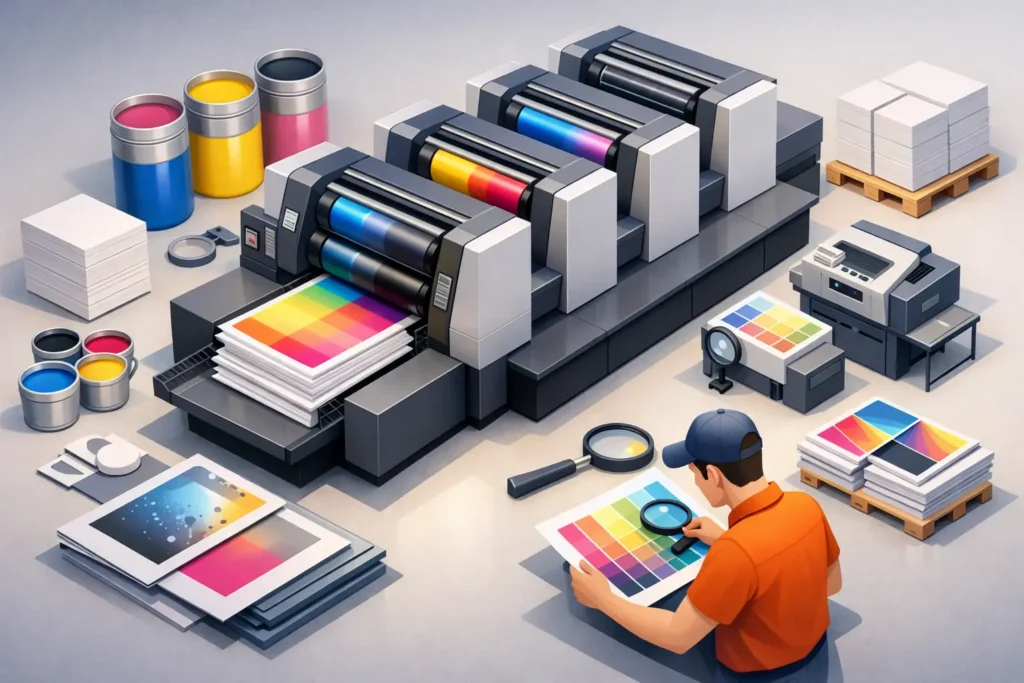
Offset printing starts with file preparation. Your artwork is separated into color components, usually CMYK – cyan, magenta, yellow, and black. A separate plate is created for each ink color. Those plates are mounted on the press, and each one applies its image to a rubber blanket.
From there, the blanket transfers the ink to the paper as sheets move through the press. Because the image is transferred indirectly, the process stays clean and highly accurate. It also works well on different paper textures and finishes.
Once the sheets are printed, they may move on to trimming, folding, scoring, binding, coating, or other finishing steps depending on the product. A simple flyer and a multi-page catalog may both begin on an offset press, but their finishing paths will be very different.
For the customer, the bigger point is this: offset printing is designed for consistency. If your brand colors need to stay steady from the first piece to the last, this method gives you a strong advantage.
Why businesses choose offset printing services
Most people don’t ask for offset printing because they love print equipment. They ask for it because they want their materials to look professional and stay on budget at higher quantities.
One major advantage is image quality. Offset presses produce crisp type, smooth solids, and excellent color reproduction. That matters when you’re printing marketing materials that represent your business in person, on shelves, at trade shows, or in direct mail.
Another advantage is cost efficiency on larger runs. Offset has setup costs because plates and press prep are involved. But once the press is running, the cost per piece usually drops. If you need a small batch, digital printing may make more sense. If you need a larger quantity, offset often becomes the smarter investment.
There’s also more flexibility in paper and finishing options. Businesses that want thick cover stock, specialty coatings, custom sizes, or premium presentation pieces often find that offset gives them more room to create the right look and feel.
Offset vs. digital printing
This is where most buying decisions happen. Offset and digital printing both have value, but they serve different needs.
Digital printing is great for short runs, quick reorders, and projects with variable data like personalized mailers. It has less setup, which means it can be faster and more economical for low quantities. If you need 50 flyers for an event next week, digital may be the better fit.
Offset printing is usually the stronger option when quantity goes up, color accuracy matters, or the piece needs a more refined finish. If you’re printing 2,500 brochures, a run of catalogs, or branded folders for a sales team, offset often delivers better value and stronger visual consistency.
It depends on the job. There isn’t one method that’s always better. A good print partner helps you choose based on quantity, timeline, budget, and how the piece will be used.
When offset printing makes the most sense
Offset is a smart choice when you’re producing medium to large runs and need a clean, professional result. That includes materials like annual reports, menus, postcards, product sheets, event programs, and retail handouts.
It also makes sense when color control is a priority. Brands with established color standards often prefer offset because it can reproduce those colors more reliably across long runs. If your printed materials need to match existing packaging, signage, or campaign assets, that level of consistency matters.
Another good use case is premium marketing collateral. Thick postcards, elegant booklets, and polished leave-behinds benefit from the quality and finishing options that offset can support. The printed piece feels intentional, not rushed.
On the other hand, offset may not be ideal if you only need a very small quantity or if your artwork changes from piece to piece. In those cases, digital is often more practical.
Common products printed with offset services
Offset printing shows up in more places than many people realize. It’s often used for brochures, catalogs, magazines, newsletters, sell sheets, stationery, inserts, rack cards, and direct mail campaigns. It is also a strong option for presentation folders, postcards, and higher-volume flyer printing.
For creative professionals and artists, offset can work well for certain promotional pieces and printed portfolios where detail and color quality need to hold up. For organizations and event marketers, it’s a dependable choice for programs, handouts, fundraising materials, and branded event collateral.
The right format depends on how the piece will be distributed. A postcard campaign has different production needs than a saddle-stitched booklet or a folded sales sheet. That’s why talking through the use case before printing is so valuable.
What affects the cost of offset printing services?
Quantity is a big factor, but it isn’t the only one. Size, paper stock, number of ink colors, coating, turnaround time, and finishing all affect pricing.
A simple one-sided flyer on standard stock will price very differently than a multi-page catalog with heavier paper, full color throughout, and binding. Rush timelines can also change the cost, especially if they affect scheduling or finishing.
Paper choice matters more than many buyers expect. Uncoated, glossy, matte, recycled, textured, or premium cover stocks each create a different feel and carry different costs. The stock you choose should fit both your budget and the role of the printed piece.
This is one reason local guidance helps. Instead of guessing which options are worth paying for, you can make choices based on the actual goal of the piece.
What to ask before placing an offset print order
Before moving ahead, be clear on the basics: quantity, final size, paper preference, turnaround, and whether the piece needs folding, scoring, binding, or coating. If color is critical, ask about proofing. If the piece is part of a larger campaign, mention that too so the print run can stay aligned with your brand.
It also helps to ask whether offset is truly the right process for your job. A trustworthy print team won’t push one method for everything. They’ll recommend the format that gives you the best result for the budget.
For businesses that want a smoother experience, working with a local commercial printer can save time in ways that online ordering often doesn’t. You can ask questions, review options, solve file issues early, and get support from people who understand both production and deadlines. That’s a big part of why companies choose a hands-on partner like Ego id Media when the project needs to be done right.
Why offset printing still matters
Print buying has changed, but offset hasn’t become outdated. It remains one of the most effective ways to produce high-quality marketing materials at scale. When your printed pieces need to look polished, hold color, and represent your brand well, offset is still a strong option.
The real question isn’t whether offset printing is old or new. It’s whether it’s the right fit for your project. If you’re printing in volume, care about presentation, and want dependable quality from piece one to piece one thousand, offset printing services are worth serious consideration.
A good print project should feel straightforward, not confusing. When you know what offset printing does best, it’s much easier to choose the path that gives your brand the right result the first time.
Leave a reply

Leave a reply